

Dedusting Large Wood Panels: How to Eliminate Static Electricity to Guarantee a Perfect Finish
Wood is an essential material. Found in most industrial and domestic environments, it is used for manufacturing furniture, kitchens, doors, interior fittings, and even floors. Appreciated for its solidity , its natural aesthetic , and its ease of transformation , it remains, however, very sensitive to static electricity during its industrial processing.
In cutting, sanding, gluing, or varnishing workshops , woodworking generates electrostatic charges. These charges retain dust and other impurities, making manual dusting often insufficient , particularly on large wood panels.
Static Electricity: The Invisible Enemy of Industrial Wood
When a wood panel passes through a production line, it undergoes various frictions: conveyors, rollers, cutting tools, brushes, or mechanical handling. Each contact generates an electrostatic charge that acts like a dust magnet.
The result:
-
Micro-particles remain stuck to the surface despite compressed air blowing.
-
The panels are not perfectly clean before varnishing, gluing, or painting.
-
Finish defects appear: bubbles, irregularities, incomplete adhesion.
These imperfections directly harm the quality of the finished product , but also productivity : rework, touch-ups, rejects, loss of raw material, and delivery delays.
Manual Dedusting is No Longer Enough
Many workshops still use classic air blowing or manual cleaning before the finishing stages. However, these solutions do not eliminate the electrostatic charges present on the wood surface. As long as this static electricity remains, dust immediately re-sticks after cleaning , leading to a slow process, imperfect surfaces, and reduced efficiency.
To permanently eliminate this problem, it is essential to neutralize electrostatic charges simultaneously with dusting.
The Elcowa Solution: The Ecovac 7 Ionizing dedusting for Wood Panels
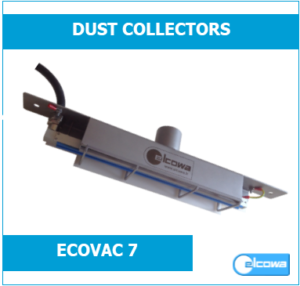
To address the issues of residual dust and electrostatic charges on large-format wood panels , Elcowa offers a complete and high-performance solution: the Ecovac 7 ionizing duster.
Designed for the most demanding industrial environments , the Ecovac 7 combines three complementary actions to ensure a deep cleaning and a perfectly clean surface before the finishing stages.
-
A mechanical action : Thanks to a brush or a blowing tube, dust and pollutant particles are detached from the panel surface, thus revealing the electrostatic charges present.
-
Electrostatic neutralization : An integrated anti-static bar instantly neutralizes the accumulated electrical charges, preventing dust from redepositing.
-
Targeted suction : A 4 mm suction slot over the entire length of the system effectively captures and removes the released impurities.
Thanks to this triple action mechanical, ionizing, and suction the Ecovac 7 guarantees a totally clean surface , ideal for gluing, varnishing, or painting wood panels. This process ensures optimal finishing quality , while reducing production losses , rejects , and touch-ups related to non-conformity.
Key Strengths of the Ecovac 7 Ionizing Dedusting system
-
Complete neutralization of electrostatic charges before each finishing stage.
-
Effective elimination of fine dust on large-format wood panels.
-
Combined system of mechanical action, ionized air, and integrated suction for uniform cleaning.
-
Easy integration onto existing production lines, even at high speeds.
-
Reduction of rejects and line stoppages , leading to increased productivity and consistent performance.
Thanks to the Ecovac 7, Elcowa supports wood and furniture manufacturers in their approach to quality, performance, and durability —a made in France solution designed for cleaner and more efficient production.


