

Helmet Dust Removal Before Lacquering: Why Static Electricity Can Ruin Your Finish
In the helmet manufacturing sector, whether it’s for motorcycle, bicycle, or industrial safety helmets, the quality of the coating is a major concern. Before the painting or lacquering stage, every surface must be perfectly clean and electrostatically neutral to ensure homogeneous adhesion and an impeccable finish.
However, many companies still encounter problems with residual particles despite meticulous manual dust removal. These invisible defects can compromise the quality of the finished product, lead to costly touch-ups, or even production rejects.
Static Electricity: The Invisible Enemy of Lacquering
During the surface preparation steps, friction between the helmet and its supports, as well as conveyor transport, generates an electrostatic charge. This charge attracts dust, plastic micro-particles, or fibers present in the air, which then stick to the helmet’s surface.
Even after manual dust removal, some particles remain firmly attached. The result: during the application of paint or varnish, these impurities create micro-defects, bubbles, or a non-uniform finish.
Besides the aesthetic aspect, these defects can lead to:
- Quality non-conformities
-
Production delays
-
An increase in rejects
-
And a drop in productivity

Why Manual Dust Removal Is No Longer Enough
Many manufacturers continue to rely on manual solutions: air blowing or rags, for example. But these methods do not always neutralize the static electricity accumulated on the helmet’s surface. However, as long as this charge subsists, particles continue to adhere to the material. The result: ineffective cleaning and a compromised painting stage. To achieve an optimal level of cleanliness and finish, it is indispensable to combine mechanical dust removal and the complete elimination of electrostatic charges.
The Elcowa Solution: Dust Removal and Electrostatic Neutralization
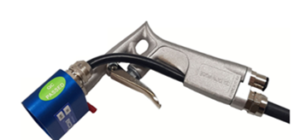
To guarantee a perfectly clean surface before painting or lacquering, Elcowa offers a simple and effective solution: the TISP-N ionizing and anti-static gun. This system combines compressed air blowing and electrostatic neutralization to eliminate all the dust, fibers, and fine particles that remain stuck to the helmets after manual dust removal. Thanks to the CORONA effect technology, the TISP-N gun generates an ionic field that instantly neutralizes the electrical charges present on the material’s surface. The compressed air diffuses this ion field over the entire surface of the helmet, allowing for complete and homogeneous dust removal before the painting phase. Compact, robust, and easy to integrate into a production line, the TISP-N ensures a high-quality result, without contamination and without unnecessary touch-ups.
Measurable Results for Helmet Manufacturers
Companies equipped with Elcowa solutions observe:
- A significant decrease in surface defects,
- Time savings in production,
- And a lasting improvement in the visual quality of their products.
Our equipment adapts to all types of helmets:
- Motorcycle and bicycle helmets,
- Construction or industrial safety helmets,
- Sports or leisure helmets,
- And any product requiring a uniform and impurity-free coating.
Optimize Your Painting Process with Elcowa
By eliminating electrostatic charges before the painting, you ensure a perfect finish, increased productivity, and a strengthened brand image. Our teams accompany each client with a tailor-made solution, adapted to the configuration of their production line.


